
Bronze is an alloy of copper and tin whose resale price per kilo primarily depends on the copper price in international markets. For an individual or a craftsman who stores bronze scraps, anticipating the buyback price in 2026 requires understanding some specific mechanisms that go well beyond simple daily quotations.
Composition of the alloy and the influence of copper on the price per kilo
Bronze contains a majority proportion of copper, generally more than two-thirds of the alloy. The remainder is mainly composed of tin, sometimes supplemented by zinc, lead, or phosphorus depending on the intended industrial use.
This high copper content explains why the copper price determines most of the bronze price. When copper rises on the London Metal Exchange, the buyback price of bronze follows with a delay of a few days. When it falls, scrap dealers adjust their prices just as quickly.
The Italian market, often used as a reference in Europe for non-ferrous metal scrap, has shown regular price increases since the beginning of 2026. Common bronze sections (without brass) rose from 7,000 euros per ton at the end of March to 7,700 euros per ton by mid-May 2026, translating to a range of around 7 to 7.70 euros per kilo in the wholesale market.
To estimate the price per kilo of bronze in 2026 when reselling to a local recycler, a discount reflecting sorting, transport, and melting costs must be applied.
Recycler discount: why the buyback price differs from the wholesale price
A scrap dealer or recycling center never buys bronze at the price displayed by wholesale quotations. The difference between the market price and the price actually paid to the seller covers several concrete items.
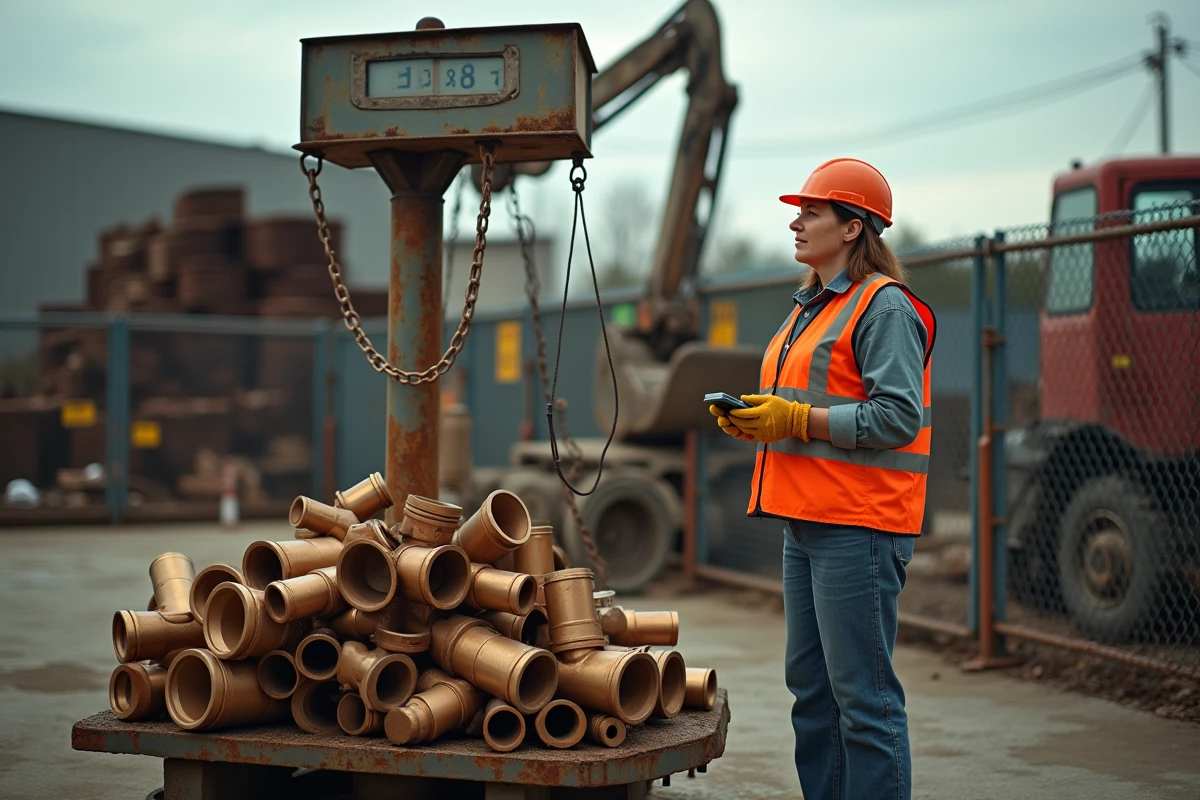
- Sorting and quality control costs: the recycler must ensure that the lot does not contain brass, iron, or other impurities. A mixed lot will be downgraded and bought back at a significantly lower price.
- Logistics costs: transport to the foundry or refiner impacts the margin, especially for small volumes. A lot of a few kilos incurs the same fixed costs as a lot of several hundred kilos.
- Energy surcharges: since 2025, many recyclers and non-ferrous metal foundries explicitly pass on energy-related surcharges for electricity and gas prices in their buyback prices, with adjustments sometimes made weekly. Eurometaux noted this practice as early as late 2024, explaining that buyback prices are becoming more volatile and more correlated with energy markets.
In practice, the discount applied by a local scrap dealer compared to the wholesale price can represent a significant portion of the price. Selling a clean, sorted lot of sufficient weight reduces this discount.
Durability premiums and traceability of recycled bronze
A recent factor is changing the game for sellers of industrial-quality bronze scraps. Since 2024, major European foundries like Aurubis have reported that their industrial clients are willing to pay a premium for certified low-carbon footprint alloys, dubbed “Low-Carbon Copper Alloys.”
This trend means that traceability and the proportion of verified recycled content increase the value of the scrap. A lot of bronze with documented origin (machining scraps, identified foundry rejects) can be negotiated at a better price than a lot of uncertain provenance.
For an individual reselling a few kilos of recovered bronze, this premium remains marginal. It mainly concerns craftsmen, mechanical workshops, and small foundries capable of providing tracking slips.
Carbon Adjustment Mechanism at Borders and bronze prices in 2026
The MACF (Carbon Adjustment Mechanism at Borders), a European system whose transitional phase began in October 2023, will be fully operational in 2026. This mechanism requires importers to declare the carbon footprint of certain semi-finished products, which increases the cost of importing metals produced outside the EU with a high carbon intensity.

For the recycled bronze market, the consequence is twofold. First, recycled bronze in Europe becomes comparatively more competitive against imported alloys, as its production generates fewer emissions than melting virgin ore. Second, this increased competitiveness supports buyback prices in the domestic market.
This structural support does not guarantee a linear increase in prices. The copper price remains the dominant factor, and a marked drop in copper prices in global markets would pull bronze down with it, MACF or not.
Selling your bronze scraps at the best price: the criteria that matter
Several concrete elements determine the price you will obtain from a recycler in 2026.
The purity of the lot remains the primary criterion. Clean bronze, without solder, without steel inserts, and without mixing with brass sells in the highest category. A mixed bronze-brass lot will always be bought back at the price of the cheapest metal in the mix.
The weight of the lot also plays a role. A recycler is more likely to travel or offer a better price for a lot of several dozen kilos than for two or three isolated pieces. Grouping your scraps before selling improves your bargaining power.
The timing of the sale matters. Prices fluctuate from week to week. Monitoring the copper price for a few weeks before selling allows you to choose a favorable window rather than succumbing to the first price offered.
The upward trend observed since the beginning of 2026 in the European bronze scrap market reflects both the strong performance of copper and the structural effects of the MACF and durability premiums. These factors will not replace vigilance regarding the quality of the lot and the timing of the sale, which remain the two most direct levers for obtaining a fair buyback price.